
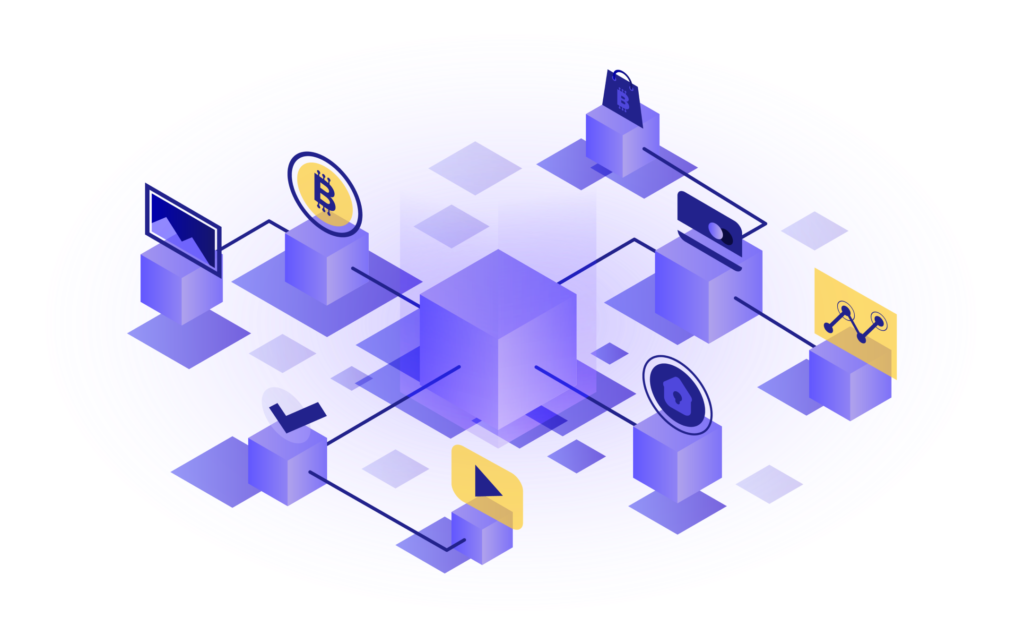
What is Blockchain?
A blockchain is a decentralised system that stores data in a network of interconnected computers. The concept of blockchain technology was first proposed in 1991. However, many people know the concept thanks to cryptocurrencies like Bitcoin and Ethereum.
To understand the Blockchain better, think of a regular company ledger that stores transaction details. Whenever transactions are initiated, they are recorded in the ledger, which is stored in a safe or on the internet for secure storage. While these storage mechanisms make for easy access, they are easy to hack or break into, and can be altered or destroyed by someone with the access. Blockchain technology looks to solve these problems.
For practical purposes, decentralisation is a key part of the blockchain as records are duplicated across many connected computers, otherwise called nodes. This allows several of these computers to participate in the continued updating of these digital ledgers or transactions while ensuring no single entity has complete control.
Blockchain Features
- Decentralization
- Immutability
- Enhanced Security
- Consensus
- Quick Settlement

How Blockchain Works
To understand how blockchain technology works, we’ll consider the Bitcoin blockchain. Bitcoin brought the technology to mass adoption when it launched in 2009.
Here's how it operates:
The network records a transfer when Bitcoins is sent from one person to another. However, the individual won’t get the cryptocurrency until it’s confirmed. Since the blockchain consists of a group of computers connected to one network, these computers, also known as ‘nodes’, work to verify this transfer. Every computer connected to the Bitcoin blockchain competes to verify this transfer. Bitcoin nodes are designed to verify and store new transactions as they happen.
Think of the verification processes you encounter at the bank when you try to cash a cheque. The same thing happens here. The nodes have to verify everything and be sure that the sender has the funds they want to send to the recipient.
To verify a transfer on the Bitcoin blockchain, the nodes:
- Confirm that the funds are available.
- Broadcast the order to other nodes, which repeat the process until more than one node confirms that the order is valid.
- Once all nodes agree that the order is valid, the transfer is sent to the mempool or memory pool. The mempool is where all transactions that are still being processed wait.
- This entire process is called Bitcoin mining.
To complete this process, Bitcoin miners are brought into the mix. A miner is responsible for confirming the transactions in ‘blocks’ before adding or ‘chaining’ these blocks of transactions to the network. This decentralised ledger is also known as the ‘blockchain’. A block is a storage unit for storing transactions. Think of the block as a folder on your system where you store digital files. Each block on the Bitcoin blockchain is connected to the one before it. These blocks form a chain of data that makes up the network.
So, what do these Bitcoin miners have to gain for doing all these? As an incentive, miners are rewarded with 6.25BTC every time they create a block of transactions and add them to the network. That’s the summary of how the blockchain works.
While Blockchain is predominantly attached to crypto, distributed ledger technology is seeing rapid adoption in industries like healthcare, real estate, and data storage. Therefore, the future is bright for blockchain technology, and we are just starting it.